Relative Clauses ~ Relative Clauses-Part 2 worksheet - Free ESL printable worksheets made by teachers. This is why they are also known as adjective clauses. Relative clauses allow us to provide additional information without having to start a new sentence. They commonly qualify or give more information about a noun. A relative clause is one kind of dependent clause. Relative clauses tell us more about people and things:
In this article, we are going to take a look at the answers to both of these questions by looking at some examples of relative clauses in use. It comes after the noun defined by a basic sentence. A relative clause is a sentence describing a noun, however, it cannot be used separately. Here are 4 steps to merging multiple sentences together. The basic relative pronouns are who, which, and that;
How to Use Relative Clause (what, when where etc) in OET Writing from edubenchmark.com Relative clauses can cause trouble in english, specially when they begin with less common forms of the pronoun who, such as whom? They are most often used to define or identify the noun that precedes them. They commonly qualify or give more information about a noun. A relative clause is a clause that begins with a relative pronoun. It is also called adjective clause because it defines a noun. Here are 4 steps to merging multiple sentences together. Defining relative clauses (also called identifying relative clauses or restrictive relative clauses) give detailed information defining a general term or expression. Relative clauses allow us to express more in a single sentence.
Defining relative clauses are not put in.
Defining relative clauses (also called identifying relative clauses or restrictive relative clauses) give detailed information defining a general term or expression. Lord thompson, who is 76, has just retired. It is also called adjective clause because it defines a noun. Various grammatical rules and style guides determine which relative pronouns may be suitable in. Who also has the derived forms whom and whose. A relative clause is a sentence describing a noun, however, it cannot be used separately. They commonly qualify or give more information about a noun. It is sometimes called an adjective clause because it functions like an adjective—it gives. Relative clauses follow whatever it is that they are qualifying. Relative clauses are clauses starting with the relative pronouns who*, that, which, whose, where, when. They are most often used to define or identify the noun that precedes them. In this article, we are going to take a look at the answers to both of these questions by looking at some examples of relative clauses in use. In english, there are two types of relative clauses:
This is the house which jack built. The relative pronoun is the subject the relative clause can come after the subject or the object of the sentence. Lord thompson, who is 76, has just retired. Defining relative clauses are not put in. Here are 4 steps to merging multiple sentences together.
Relative Clauses Display by StevenHodgkinson - Teaching Resources - Tes from dryuc24b85zbr.cloudfront.net Relative clauses allow us to express more in a single sentence. It comes after the noun defined by a basic sentence. Since relative pronouns are an essential part of relative clauses, let us first discuss what relative pronouns are. It is also called adjective clause because it defines a noun. Relative clauses tell us more about people and things: They may add meaning, but if they are removed, the sentence will still function grammatically. Relative clauses can cause trouble in english, specially when they begin with less common forms of the pronoun who, such as whom? They are most often used to define or identify the noun that precedes them.
A relative clause is a sentence describing a noun, however, it cannot be used separately.
Relative clauses in the english language are formed principally by means of relative pronouns. When to use which and. Various grammatical rules and style guides determine which relative pronouns may be suitable in. The basic relative pronouns are who, which, and that; Relative clauses allow us to express more in a single sentence. Who also has the derived forms whom and whose. Lord thompson, who is 76, has just retired. Since relative pronouns are an essential part of relative clauses, let us first discuss what relative pronouns are. A relative clause is a clause that begins with a relative pronoun. Here are 4 steps to merging multiple sentences together. Relative clauses allow us to provide additional information without having to start a new sentence. This is why they are also known as adjective clauses. In this article, we are going to take a look at the answers to both of these questions by looking at some examples of relative clauses in use.
A relative clause is a clause that begins with a relative pronoun. Relative clauses tell us more about people and things: In english, there are two types of relative clauses: A relative clause is a subordinate clause that contains the element whose interpretation is provided by an expression on which the subordinate clause is grammatically dependent. Relative clauses allow us to express more in a single sentence.
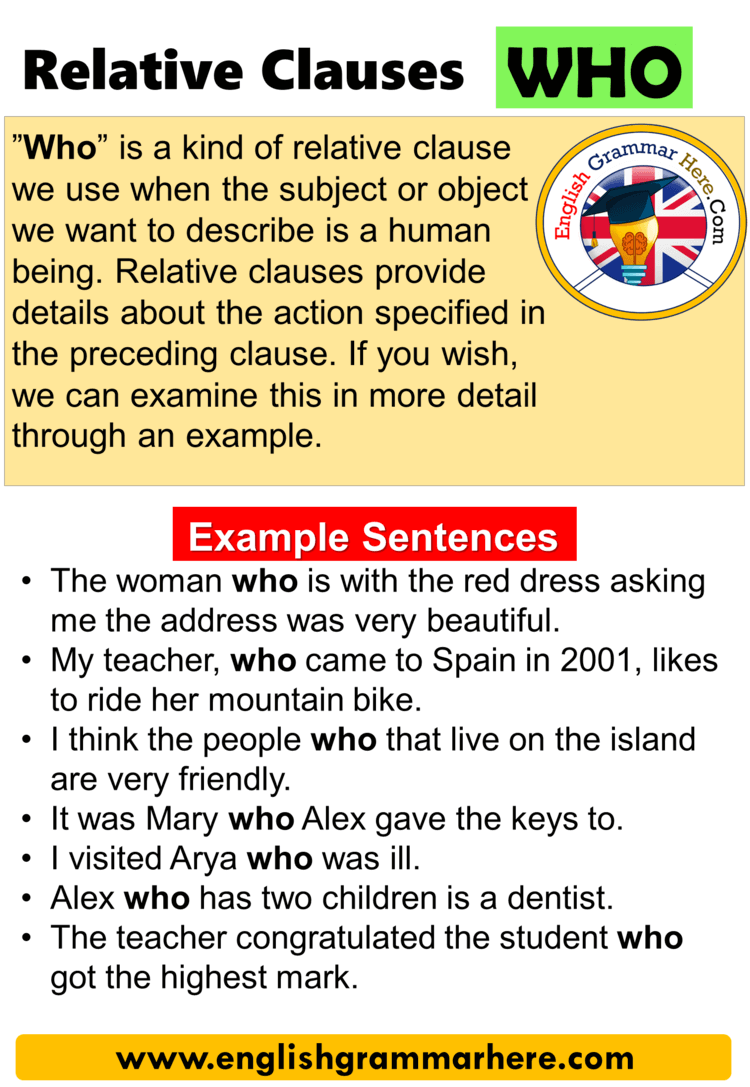
Relative Clauses with Who, Definition and Examples - English Grammar Here from englishgrammarhere.com Relative clauses allow us to express more in a single sentence. It has a subject and verb, but can't stand alone as a sentence. Relative clauses in the english language are formed principally by means of relative pronouns. A relative clause is a clause that begins with a relative pronoun. Relative clauses follow whatever it is that they are qualifying. They commonly qualify or give more information about a noun. Here are 4 steps to merging multiple sentences together. It is sometimes called an adjective clause because it functions like an adjective—it gives.
A relative clause is one kind of dependent clause.
A relative clause is a clause that begins with a relative pronoun. Lord thompson, who is 76, has just retired. This is why they are also known as adjective clauses. Various grammatical rules and style guides determine which relative pronouns may be suitable in. A relative clause is one kind of dependent clause. Relative clauses can cause trouble in english, specially when they begin with less common forms of the pronoun who, such as whom? They may add meaning, but if they are removed, the sentence will still function grammatically. The relative pronoun is the subject the relative clause can come after the subject or the object of the sentence. Relative clauses allow us to express more in a single sentence. Defining relative clauses are not put in. Since relative pronouns are an essential part of relative clauses, let us first discuss what relative pronouns are. Relative clauses are clauses starting with the relative pronouns who*, that, which, whose, where, when. Relative clauses allow us to provide additional information without having to start a new sentence.